
English| EUR
Suggested for you
More currencies
Choose a language
Kingsford Smith sits closer to the centre of its city than almost any other major international gateway — roughly eight kilometres from the CBD, with Botany Bay on one side and Mascot's low streets on the other. That proximity flatters the map and misleads the clock. This guide sets out the window in which transfers actually run, the structural facts that shape any door-to-door estimate, and where the real slack in a schedule lives.
Quick answer
Plan around a service window of 05:00–23:00, when public transport and ground services at Sydney Airport operate; terminals themselves are closed overnight, and posted terminal hours run 03:00–23:00 daily. Entry to the terminal is free at 0 AUD, with each transport service charged separately. The caveat that catches most travellers is the split site: T1 International and T2/T3 Domestic sit on opposite sides of the runways.
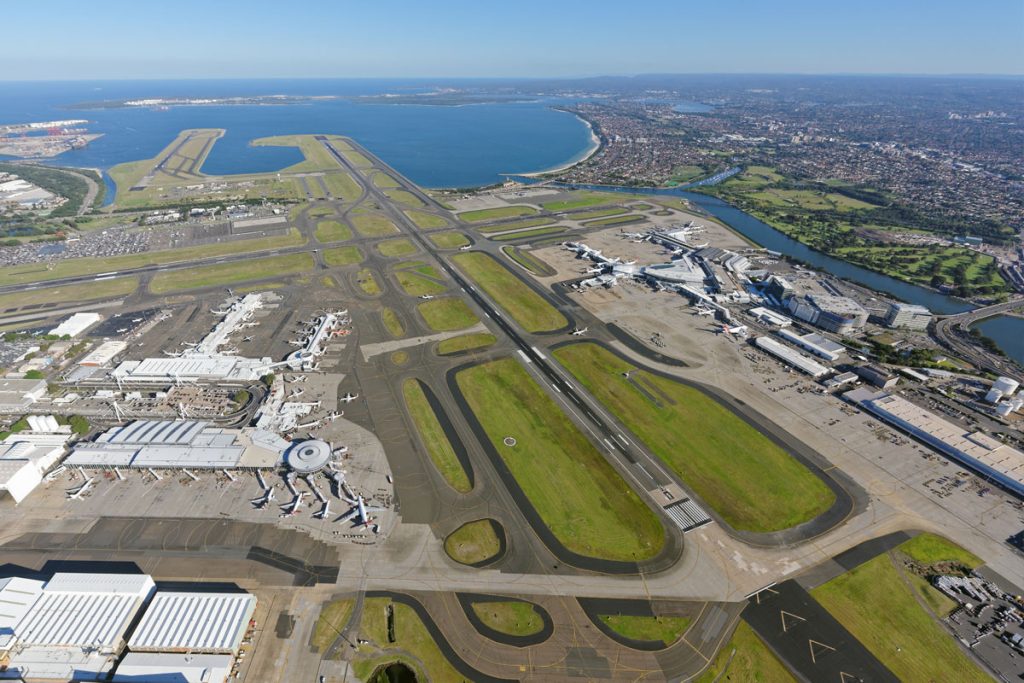
Sydney Airport predates Heathrow, Schiphol and JFK as a working aerodrome — aircraft have used the Mascot sandflats since 1920, and the site has never moved. The consequence is a gateway wedged into an established suburb at Sydney Airport, Mascot NSW 2020, Australia, hemmed by Botany Bay, the Cooks River and the Alexandra Canal. Nothing about that geometry can be widened. Every sydney airport transfer time estimate a traveller reads is really a statement about eight kilometres of constrained road and rail corridor, not about distance. The first thing to understand is that the airport is not one place. T1 International stands on the western side of the field; T2 and T3, the domestic terminals, stand on the eastern side. They share a name and a postcode but no walkway. Anyone connecting between them crosses the runways by shuttle or by a single stop on the rail line, and that transfer sits inside the journey plan as a separate leg. Travellers who budget only for the run into the city, and forget the internal crossing, are the ones who arrive flustered at the gate. The second structural fact is the service window. Terminals close overnight, and the recommended arrival window of 05:00–23:00 exists because ground services and public transport are running then. A red-eye landing at 04:00 is not a scheduling problem so much as a category problem: the reader is no longer planning a Sydney airport transfer at all, but a night arrival with limited options. Checking the flight time against that window is the single most useful thing to do before booking anything, and the official site at https://www.sydneyairport.com.au or the terminal line on +61 2 9667 9111 will confirm current conditions. What should a reader do with all this? Treat the headline figure as a floor, not a promise. Sydney airport transfer time varies by direction, by hour and by which terminal is involved, and the honest planning approach is to identify the fixed constraints first — terminal, service window, the internal crossing — then let the variable elements settle around them. The dedicated sections on this page break out door-to-door durations, the modes available from each terminal forecourt, the hours in full, and what each option costs. Read those with the geography above in mind; the numbers make far more sense once the shape of the place is clear.
“T1 and T2 share a name and a postcode but no walkway — the crossing between them is a leg of the journey, not a footnote to it.”
This timeline suits a visitor landing at Sydney Airport and heading into the CBD, mapping out how long each stage of the transfer actually takes from wheels-down to hotel door. Budget roughly 2 hours 15 minutes end to end, of which about 20 to 50 minutes is the transfer itself.
Aircraft touches down at Sydney Airport, Mascot NSW 2020, and taxis to the gate. Allow 10 to 15 minutes from landing to the door opening, longer at peak arrival banks when a bay is occupied.
Clearing SmartGate or a staffed desk plus baggage reclaim typically runs 30 to 60 minutes at T1 International, less at T2 and T3 domestic. Your transfer clock only starts once you exit the arrivals hall.
Airport Link station sits directly beneath T1 and beneath T2/T3, while the taxi and ride-share ranks are on the forecourt. Walking to either takes 5 to 10 minutes with luggage.
The train from either station to Central runs about 13 minutes, or roughly 20 minutes to Circular Quay via a change. Services run every 10 minutes or so and are unaffected by road conditions.
By road the same trip averages 20 to 25 minutes off-peak and 35 to 50 minutes in weekday peaks. Eastern Distributor congestion is the usual variable.
You reach a central Sydney address between 20 and 50 minutes after leaving the terminal. Add 15 to 20 minutes if your accommodation is in the Inner West, North Sydney, or Bondi.
Plan 45 minutes from exiting arrivals to your door on a quiet Sunday, and 75 minutes on a Friday afternoon. Build the wider figure into any onward booking.
Sydney Airport is located in Mascot and is accessible via several transport modes that connect directly to the terminal precincts. Choosing between rail and road options significantly influences your total transfer time.
Airport Link T8 Airport & South Line to Domestic or International Airport Station
M1 or Airport Drive to terminal drop-off zones
M1 or Airport Drive to designated Priority Pick-up zones
For the most predictable travel time, the Airport Link train bypasses road congestion. Aim to arrive during the operational window of 05:00–23:00 to ensure all transport services are available.
The best arrival window is 05:00–23:00 to align with service availability and avoid overnight terminal closures. Planning travel outside of Sydney's peak traffic periods remains the most effective strategy for consistent transfer times.
—
Road congestion significantly impacts transit times during these hours. Allow extra buffer time if your journey coincides with these periods.
—
Peak hour traffic slows major arterial routes to and from the airport. Scheduling transfers outside this window reduces wait times.
Mild, 12°C to 23°C
Spring offers stable weather and fewer major holiday surges. This period generally experiences more predictable road conditions compared to summer peaks.
Mild, 14°C to 22°C
Autumn provides clear weather and steady traffic patterns. Mid-week travel during these months typically offers the most reliable transfer experience.
Verdict: The most efficient time for airport transfers is mid-week, Tuesday to Thursday, during the mid-morning or early afternoon hours in April or October.
Sydney Airport operates on a consistent daily schedule to facilitate passenger transit. The terminals maintain set operating hours that influence the availability of transfer services.
While entry to the terminal itself is 0 AUD, travelers must budget for the specific fees associated with their chosen mode of transport. Costs for transfers vary depending on the service provider and the distance to your destination.
Verdict: A typical adult pays a variable fare depending on the transport mode chosen and the distance traveled to their final destination.
Work through these steps in order, from the weeks before your flight to the moment you leave for Sydney Airport, to keep your transfer time under control.
Everything you need to know about sydney airport transfer time
The typical duration depends on your choice of vehicle and traffic conditions between the city center and Mascot. Most passengers find that private car services offer a consistent schedule compared to other methods. Planning your journey ahead helps manage your expectations for the overall trip duration.
Yes, traffic congestion during peak hours can significantly influence your journey. It is recommended to monitor live transit updates to ensure your arrival aligns with your flight schedule. Choosing a reliable service provider helps mitigate delays during these busy periods.
Taking the train or bus generally takes longer than a direct car service due to scheduled stops and station navigation. These modes of transport remain popular for those seeking a budget-friendly way to reach the airport grounds. Always check the current timetable to confirm your departure time.
All terminal facilities are closed overnight, meaning transit services operate strictly within the window of 03:00 to 23:00 daily. You should ensure your arrival at the airport falls within these hours to avoid issues with terminal access. Planning outside of this period is not recommended as services cease operation.
You should aim to arrive within the best arrival window of 05:00 to 23:00 for the smoothest experience. Calculating your sydney airport transfer time effectively requires adding buffer time for potential road delays. This preparation ensures you reach the departure gates with sufficient time for security and check-in.
Terminal entry is 0 AUD, as public access to the airport grounds is free of charge. You will only need to account for the individual costs associated with your chosen transport service. Fees for these specific transport options are separate from general airport access.
Road traffic in Sydney fluctuates throughout the day, which directly influences the expected transit duration. Travelers should consider the time of day when booking a vehicle to avoid the heaviest congestion periods. Using navigation tools can provide a more accurate estimate of your arrival time.
Domestic to International Terminal Transfers
Read more Tickets & toursTransfers to Sydney Cruise Terminal
Read more GuideAirport Pick Up and Parking Guide
Read more Tickets & toursSydney Airport Transfer Bus
Read more Tickets & toursPrivate Sydney Airport Transfer
Read more Tickets & toursSydney Airport Transfer to Hotel & City
Read more Tickets & toursSydney Airport Transfer with Baby Seat
Read more